

Scott kept his eyes on the window. Something in him insisted that if he looked away, even for a second, the man beneath the trees would move. Clara’s hand found his arm and gripped hard enough that he felt her nails through his sleeve. The figure stood exactly where he had stood a moment before, black coat unmoving against the pale wash of morning light, and then Scott blinked anyway, he couldn’t help it. When he opened them the treeline held nothing but trees.
“Where did he go?” Clara asked. Her voice had gone thin and careful, the voice of a woman trying to keep a question from becoming a scream.
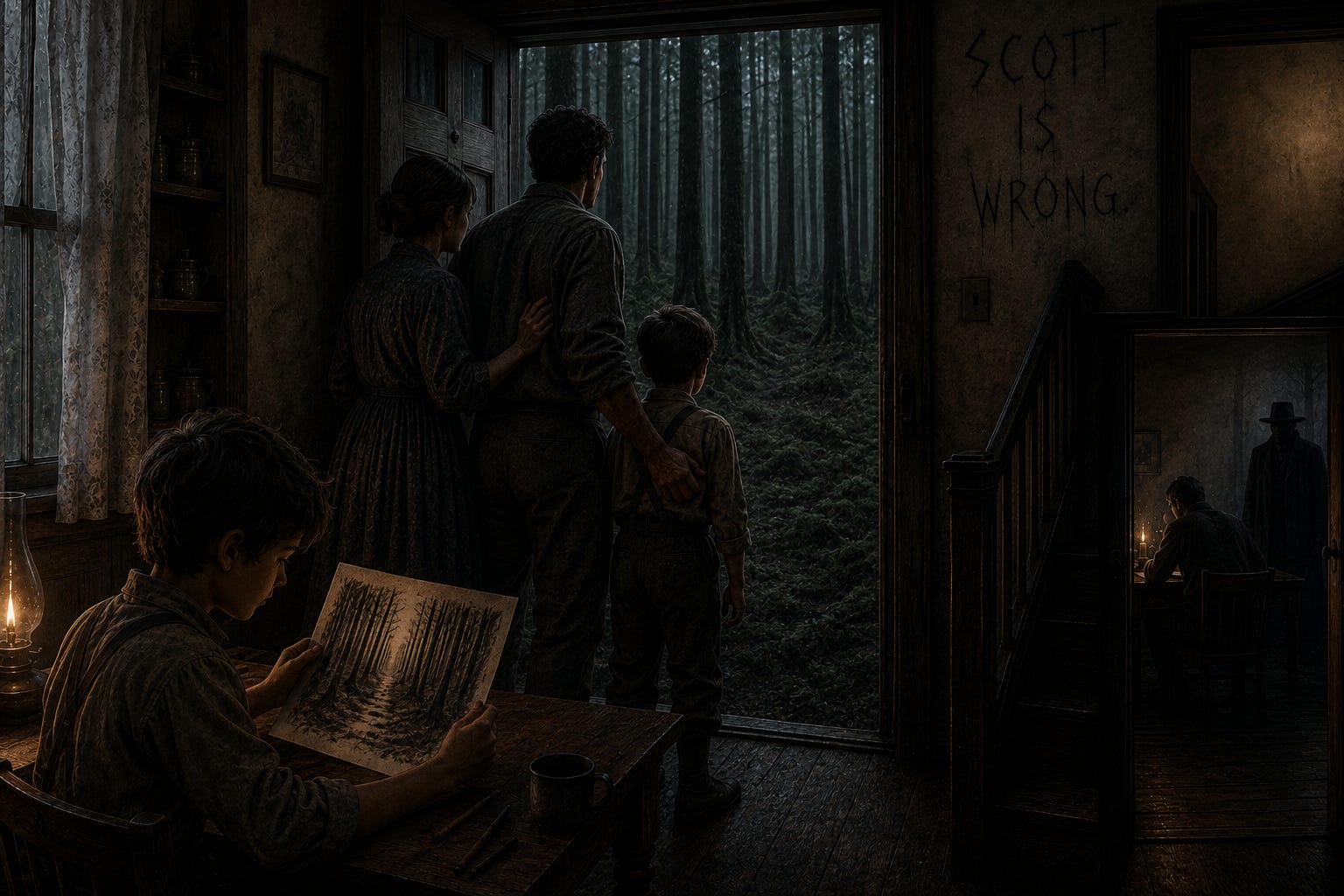
Scott did not answer her. He was already moving toward the door. As he passed Danny, who sat at the kitchen table with his head bent over the paper, pencil moving steadily across the page, Scott caught a glimpse of dark vertical lines crowded together. Danny did not look up.
He rushed to the front door, already working the bolt free with hands that did not want to cooperate, and when he stepped out onto the porch the cold morning air struck him with none of the ordinary bite of a coastal autumn. It felt used, somehow, disturbed, the way a room feels when someone has just left it. He crossed the yard toward the trees with his heart working hard against his ribs, and at the edge of the garden he stopped and looked down at the mud.
The footprints began at the treeline. There were no tracks leading toward it, only the deep impressions of boots coming away from the trees. The prints went across the soft ground in a line so straight it looked measured. Scott followed them with his eyes back toward the house. They ended beneath the kitchen window, deep and clear in the wet earth. Whoever had stood there had stayed long enough to sink deep into the mud..
There were no prints leading away.
Scott stood in the cold for a long moment with his own breath fogging in front of him, and then he turned and went back inside without saying anything to explain why his hands had begun to shake.
He checked every door. The front bolt was thrown exactly as he had left it the night before. The back door, the one that led out past the woodpile, was latched from the inside in the particular way he always latched it, a habit worn so deep into him that he would have noticed instantly if it had been disturbed. The windows along the writing room wall were fastened. Nothing showed that anyone had entered the house. Scott checked the doors again anyway. By now he had stopped trusting evidence simply because it looked ordinary.
He was still standing in the front hall when Thomas came down the stairs, moving with his ordinary unhurried morning heaviness, one hand trailing along the banister the way he always did. He looked entirely himself, tousled and sleepy and unconcerned, and for a moment Scott let himself believe the morning might simply continue as mornings did.
“Papa,” Thomas said, stopping two steps from the bottom, “who’s that man in the hallway?”
Scott’s stomach dropped somewhere below the floorboards. He turned and looked behind him at the empty hall, the coat hooks, the small table where Clara kept a dish for buttons, nothing else. At the far end, near the writing room, stood a figure.
Only a silhouette.
Scott stopped.
The figure had its back to him and was facing the Desk.
Scott blinked.
Gone.
“There’s no one there, Thomas,” he said, and heard how unconvincing his own voice sounded even to himself.
Thomas frowned. It was the expression he wore when an adult had gotten something wrong. He pointed, not toward the front door where Scott had been watching the treeline, and not toward the kitchen where Clara still stood pale beside the stove, but toward the writing room, where the desk sat quiet and undisturbed in the gray daylight.
“He was right there,” Thomas said. “By the desk. He looked like Grandpa.”
He looked like Grandpa... the words echoed in his head as Scott stared at him. For a moment he couldn’t think of anything to say. “What did you say?”
“Grandpa.”
Scott had never shown Thomas a portrait of his father. There were no photographs of the old man anywhere in the cottage, nothing Thomas could have seen, no story Scott had ever told him that included a description of the face. He crouched down in front of his son and made himself keep his voice gentle, though gentleness cost him more effort than it ever had before.
“What did he say to you?”
Thomas’s frown deepened, the look of a boy trying to be accurate about something that troubled him more than he had words for.
“He said you shouldn’t be here,” Thomas said.
Scott left Thomas with Clara at the kitchen table. Danny was still there, his pencil moving quietly across the paper as though nothing in the house had changed. Scott went into the writing room alone, closing the door behind him out of some instinct he did not examine too closely. The desk sat where it always sat, black and patient in the morning light, and the center drawer, the one he had closed himself not an hour before, stood open.
He approached it slowly. The pages inside had not been touched, or so he thought at first, his father’s cramped private hand still filling the sheets he had already read that morning. But beneath the final line, beneath the sentence about not being able to bear Scott’s aloneness, a new line had been added in ink that had not been there before, pressed into the page with a force that had raised the paper slightly at the letters.
HE HAS COME TO FINISH YOU.
Scott stared at the sentence until the words blurred. He rubbed at his eyes and looked again. They were still there. Then he made himself look closer, because something about the hand troubled him in a way that went beyond the sentence itself, and when he understood what he was looking at, the room seemed to grow smaller around him.
It was not his father’s writing.
It was his own.
The cold came into the room the way it always came, settling into his teeth before it reached his skin, and Scott looked up from the page already knowing what he would find. His father assembled out of the air above the desk more quickly than before, and more wrongly, his face pulled sideways as though something were dragging at it from a direction Scott could not see. His hand reached out, fingers half formed, and pointed not at Scott but past him, toward the stairs, toward the room where Clara had gone still with fear only minutes earlier.
“Father,” Scott said. His own voice sounded very young to him.
His father’s mouth worked without sound for a long moment, the visible effort of a man fighting something that did not want him to finish a sentence. Then, in a rush, as though he had found a crack to push the words through before it closed again:
“Don’t let him.”
The shape convulsed, ink threading backward through it in long tearing strands, and Scott stepped forward without thinking and reached for him, knowing even as he did it that his hand would find nothing solid.
“You were never supposed to,” his father said, and his eyes, for one final unbearable second, held something that was not warning but grief, an apology aimed directly at his son. Then he was gone, pulled apart into the cold air the way a page comes apart when it is torn rather than turned.
Scott stood alone in the writing room with his hand still outstretched toward nothing, and that was when Clara screamed.
He opened the door and nearly collided with Danny, who was still sitting at the kitchen table. The pencil had never stopped moving.
He was up the stairs before the sound had finished, taking them two at a time with no memory afterward of how he had crossed the hall. Thomas stood frozen halfway along the corridor, small and white-faced, staring toward the bedroom door where Clara stood in the same posture Scott had come to dread, rigid, unmoving, her eyes fixed on something in the room that Scott could not yet see.
The bed was empty. The blankets lay undisturbed, the pillows still holding their shape from the night before, and for one confused instant Scott’s mind reached for relief before he understood that relief was not what this room was offering.
“What is it?” he asked, and Clara did not answer with words. She only pointed, her arm trembling, toward the wall above the headboard.
Three words had been gouged into the plaster, not written, not painted, but scratched, the marks deep and uneven as though carved by fingernails or something with the same shape and none of the softness.
SCOTT IS WRONG.
He heard himself say no before he had decided to say anything at all, and the word came out smaller than he intended, a boy’s word rather than a man’s, because in that instant he understood something he had been circling for weeks without letting himself land on it directly.
Scott heard himself say no before he knew why. The words on the wall seemed to settle something he had been afraid to admit. The Puritan was not simply watching the house. He was looking for something. Scott’s eyes moved toward Clara, then Thomas, and finally in the direction of the writing room below them.
He didn’t know which of them the man wanted.
That uncertainty frightened him more than the words on the wall.
As Scott turned toward the stairs, he glanced through the open bedroom door and down into the kitchen. Danny was still sitting at the table.
Still drawing. Scott almost called his name.
He didn’t.
He got Clara and Thomas moving without fully deciding to. His hands did the work his mind could not yet organize, pulling Clara toward the stairs and calling for Danny and Thomas to follow. Danny came without a word, still carrying his paper. Scott caught his wrist as they reached the front hall.
“Come on.”
Danny looked down at the drawing. Scott did too. It was a forest.
Not a child’s forest made of a few crooked trees and a sun in the corner.
These trees were packed tightly together, their trunks running all the way to the top of the page. There was no road. No garden. No house.
Just trees. They came down together into the front hall with the particular haste of people who no longer trust the walls around them. Scott reached the door and threw it open, already picturing the wagon road and the long walk toward the lights of Blackwater Cove.
The road was not there.
Where the muddy track should have run down toward the trees and on toward the distant lanterns of the town, there was only forest, dense and unbroken, trunks pressed close together in a configuration Scott had never once seen from this porch in all his years of standing on it. The garden was gone. The stone path was gone. There was only the porch, and beyond it, trees that stood too close together. Scott knew this view. He had looked out over this yard for years. There had never been a forest there.
Scott looked down at Danny’s drawing again.
The same trees.
The same impossible wall of forest.
His mouth went dry.
He looked at Danny.
Danny was not looking at the drawing anymore.
He was looking into the forest.
Danny folded the drawing once and held it against his chest.
“Scott,” Clara whispered, and he had never heard his name carry so much fear in it before.
He turned back toward the house, some part of him still hoping the ordinary rooms behind them might offer a version of shelter, and found the writing room door standing open at the end of the hall, though he was certain he had shut it. Through the gap he could see the desk, and the shape of a man seated at it in the posture Scott knew from years of watching his father work, shoulders bent forward, pen in hand.
Behind that seated shape the Puritan stood behind him, watching.
Then every candle and lamp in the cottage went out at once, and the darkness came down over them complete and immediate, and somewhere at the end of the hall, in the room that should have held nothing at all, Scott heard the slow deliberate scratch of a pen moving across paper.
A drawer slid open in the dark.
And out of the blackness, thin and desperate and closer than it had any right to be, his father’s voice reached him one final time.
“Scott.”
A pause that seemed to last the length of a held breath.
“Run.”