


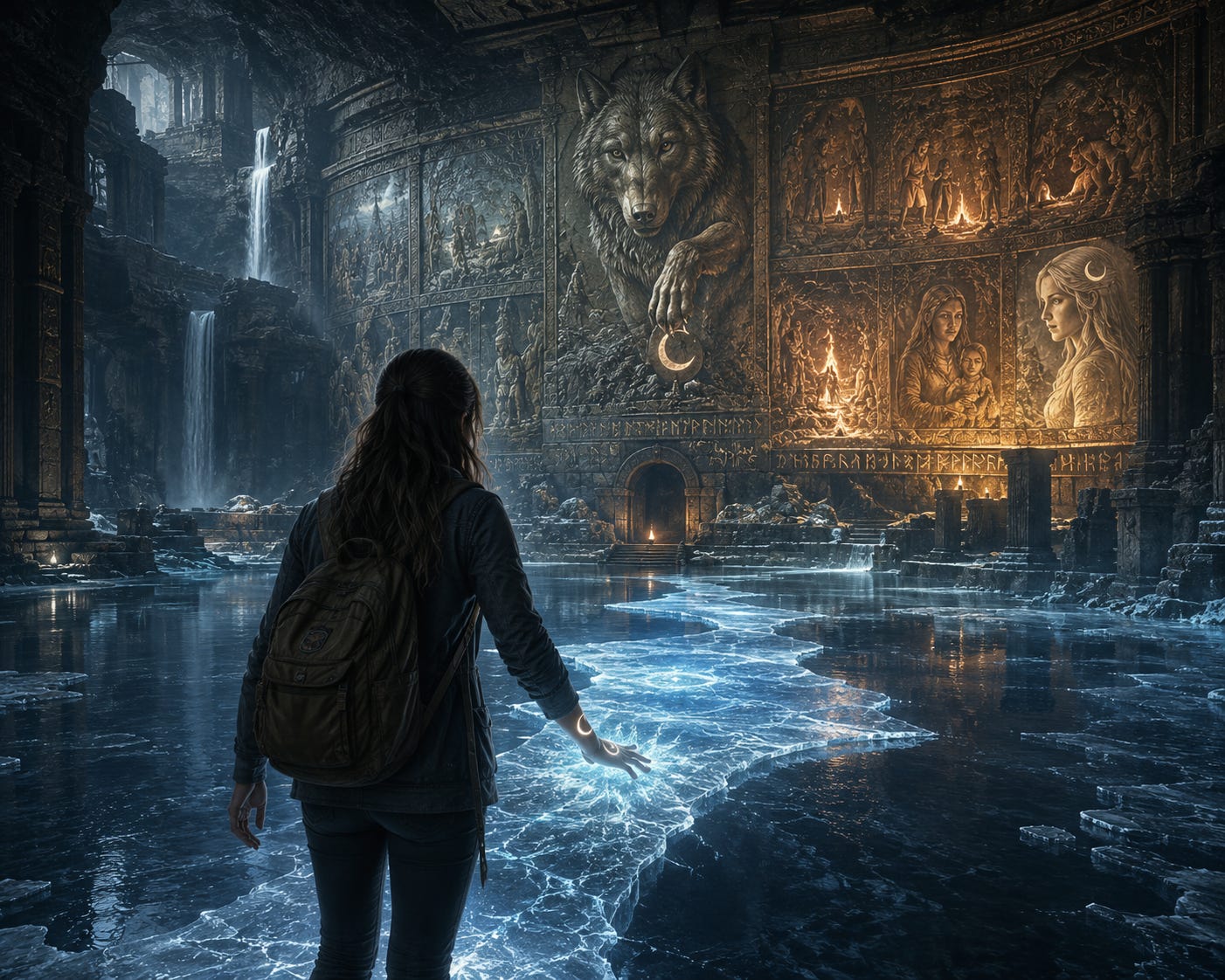
The stairs did not end so much as they stopped being stairs, worn smooth by feet that had climbed them long before Elva had a name for what she was. Her boots crunched on ancient, damp stones as she began to descend, the air chilling around her and filling with the earthy scent of underground water. Somewhere below, a drip landed on stone in a slow, patient rhythm. She kept one hand against the wall, more for the cold comfort of touch than for balance.
The Voice said nothing.
She noticed the silence more than she had expected to. For eighteen years it had told her when to move, when to hide, when something in a room had gone wrong before she understood why. Now it simply walked with her, curious but present, and quiet, and the absence of instruction unsettled her more than a warning would have. She was choosing this. No one had cornered her into it, no threat had forced her hand, and some old, tired part of her mind kept waiting for the Voice to tell her to turn back, anyway.
It never did.
The stairs opened into a chamber larger and more magnificent than Elva had expected.
She stopped at the threshold and let her eyes adjust. Cold fire pits ringed the floor in a rough circle, their stone blackened but long dead. At waist-height, shallow niches carved into the walls bore the smooth, familiar wear of countless hands brushing against them over the years. The floor itself dipped in places, shallow grooves pressed into rock by feet that had walked the same paths over and over until the stone gave way to them.
People had lived here. Not hidden, not crouched in darkness, waiting to be found. Lived, the way a family lives in a house, with routines and worn spots and places things were kept because that was where they always went. Elva turned slowly in the center of the chamber, and the realization settled into her chest with a weight she hadn’t braced for. This wasn’t a hiding place built out of fear. It had been a home at one time.
The far wall carried the carvings.
They began simply enough near the chamber’s edge, close enough to the entrance that torchlight would once have reached them easily. Figures moving through a hunt, small and worn but unmistakable, wolves and people rendered almost the same way, as if the artist hadn’t bothered separating the two. Children chased each other across a panel near a carved fire. Someone knelt beside someone else, tending a wound, or maybe just resting a hand against a shoulder. Elva walked the length of it slowly, one hand trailing just above the stone without quite touching it.
The carvings grew older as she moved deeper along the wall, the style cruder, the figures spaced further apart, as though there had once been far fewer people to carve at all. She reached a section unlike the rest, a cluster near the wall’s beginning where the stone had been worked with more care despite its age, one figure set apart from the others and repeated twice more further down, the way something gets repeated when the people carving it wanted to be certain it wasn’t forgotten. Beneath it, worn almost to nothing but not quite gone, a name.
Fenrir.
The name meant nothing to her. Nothing in her life had ever handed it to her, not in a classroom, not in a warning whispered by adults who thought she was asleep, not even in anything Kael or Hati had said aloud in her hearing. But the mark beneath the letters snagged at something anyway, a shape her mind reached for and almost placed, something close to the crest on Hati’s collar or the insignia Daniel had once described on an elite W.A.R.D. uniform without either of them realizing the connection sat there waiting. She pressed her palm flat against the stone. It warmed under her hand, sharper and faster than it had for anything else on the wall.
The Voice went very still.
“What?” she asked.
It took longer to answer than she expected. When it did, the calm in it had thinned into something else, something closer to caution than certainty.
“That’s not a story,” it said. “That’s a beginning.”
She waited for more. Nothing came. She let her hand drop, filed the name away somewhere she couldn’t afford to examine it yet, and made herself keep walking, because the wall wasn’t finished and neither was she.
Further down, near where the carvings thinned toward blank stone, she found the girl. White fur. A crescent mark at the temple, small and deliberate, the kind of detail a carver includes because it matters and not because it fills space. Roughly Elva’s age, or however age translated onto stone that old. Not her, exactly; the face was wrong, the stance different, someone else’s life pressed into rock long before Elva’s mother had been born, let alone Elva herself. But unmistakably the same kind of creature, the same mark, the same white coat catching whatever light had once reached this wall.
Her palm warmed again, gentler this time.
“I remember this,” the Voice said.
Elva went still.
The words came before she had asked anything, which was unusual enough to make her turn from the wall toward the empty chamber, as though the Voice might somehow be standing there. She stared into the darkness for a moment before looking back at the carvings.
“You remember this?” she asked. “You’ve never been here. Neither have I.”
The Voice didn’t answer.
Elva waited, her hand still resting against the stone. Whatever the Voice had recognized, it wasn’t offering an explanation, and for once she didn’t know whether that was because it couldn’t answer or because the answer was something neither of them was ready to understand.
She slowly pulled her hand away from the wall.
The floor dipped again a dozen yards further in, and she didn’t see the water until her boot was already in it.
She pitched forward, catching herself with a hand slapped flat against the surface, braced for the cold shock of a splash that never came. Ice spread from her palm instead, fast and involuntary, a thin white bloom racing outward across what had been standing water a half second earlier. She stayed frozen there, crouched and breathing hard, staring at her own hand as if it belonged to someone else.
“Did I…” she started.
“Yes,” the Voice said, and for once it didn’t sound like it was explaining anything. It sounded almost as surprised as she felt.
She stood slowly, testing her weight on the ice with one boot before trusting it with both. It held, solid enough to walk on, thin enough that she could see the shadow of deeper water moving beneath it if she looked too long. She crossed without looking down again, one careful step after another, her breath fogging in air that had gone colder than it had any right to be.
On the surface, the fire had burned low, and Kael hadn’t stopped watching the tree line for over an hour.
“You went down there,” he said finally, not looking at Hati so much as at the dark beyond the ruins. “When you were her age.”
Hati didn’t answer right away. She sat with her back against stone that had probably held up other backs the same way for centuries, her sword laid flat across her knees, and when she finally spoke, her voice carried none of the sharp edges she usually kept close to hand. “Someone told me I was ready,” she said. “I wasn’t. I went anyway.”
“What did you see?”
“A large chamber. Maybe for meetings, for rituals. Walls with names… too many to recall.” She turned the blade slightly in the firelight, not really looking at it. “I didn’t understand any of it then. I found this blade and thought it was the answer. It has been 200 years, I’m not certain I understand all of it now.”
Kael waited a moment before asking the question that had clearly been bothering him more than the others. “Why didn’t you tell her? Before she went down. You could have told her what to expect.”
Hati looked toward the ruins, toward the stairs neither of them could see from here but both of them knew were there. “Because the only thing I could have told her was that I got far enough to know I wasn’t ready.” she said, “I found what I was meant to find at the time.” Hati’s gaze returned to Kael. “She wouldn’t have known what she was looking at. I didn’t.” She set the sword aside and didn’t say anything else, and Kael, for once, didn’t push her.
Voss laid the three false trail reports side by side across the table and stared at them until the pattern stopped being a coincidence.
“They’re not trying to get her out,” he said slowly.
Fenrir stood at the edge of the room, arms folded, watching his son work through it the way a man watches weather form on a horizon he already knows is coming. Voss didn’t look up. He traced a finger along the map, from the false trail to the second contradicting scent to the drone interference, and let the shape of it settle into something he could finally act on. “If they wanted her out, this is the wrong way to do it. Too many resources were spent keeping us occupied instead of getting her clear.”
“Then what are they doing,” Fenrir said. Not a question, not from him.
“Keeping us away.” Voss’s finger stopped on a section of the map that had been marked and dismissed weeks ago as empty terrain. “Not protecting her. Protecting a place.”
Fenrir studied the map a moment longer than he needed to, and something in his expression shifted, not warmth exactly, but a kind of attention he hadn’t given his son in this room before. He didn’t say whether he approved. He didn’t need to. When he turned to leave, he left the order unspoken but understood, and Voss was already redrawing the search grid before the door had finished closing behind him.
Deeper in, the chamber, Elva found carvings, tables, and statues that were buried under inches of dust and debris. Even her footprints showed clearly on the floor from the water’s edge.
Here, the style was distinctly older, with figures meticulously crafted, hinting at the profound dedication of their creator. She touched the stone without quite deciding to, and the mark on her palm answered faster than it had anywhere else in the chamber, warm enough now that she felt it in her wrist.
“This is where they waited,” the Voice said.
“Who?” she asked.
It took a moment. When the answer came, it didn’t sound like the Voice reciting something it had always known. It sounded like something surfacing from further down than usual, reluctant and a little unsteady.
“The ones we came from.”
Elva let her hand fall away from the stone. She didn’t ask what that meant. Some part of her understood, without being told, that the Voice didn’t fully know either, and pushing at an answer that wasn’t finished forming would only break it before it could.
She found the box in a niche near the chamber’s far end, small and stone-lidded, tucked into a hollow at exactly the height a child might have reached to hide something they wanted kept safe.
Inside, wrapped in cloth that came apart at her touch, was a wolf carved from wood. Small enough to fit in one hand, its edges softened by years of being held, one ear worn nearly smooth the way a favorite toy wears smooth from being rubbed between someone’s fingers without them ever noticing they were doing it. Elva turned it over once, twice, and felt something in her chest give way that she hadn’t braced for, sharper than the cold, harder to name than fear.
This wasn’t a legend. This wasn’t extinction, or myth, or a word in a classified file. Someone had carved this for a child who had a name and a birthday and someone waiting for them to come home, and none of that had saved them.
“They were not the last,” the Voice said quietly.
Elva closed her hand around the wolf and said nothing at all. Above her, dust drifted down through a crack in the ceiling she hadn’t noticed before, catching the last thin light like something falling very slowly, in no hurry to reach the ground.