

The people in the cages did not know what to do with the freedom.
Ruth Calder stood beside the open gate with one hand on the shoulder of the boy she had been holding since the shooting started, while the others crowded behind her and stared at the bodies scattered across the equipment yard. Nobody seemed willing to be the first one to step into the open. The cage doors hung wide, the locks dangling from their hasps, and beyond them the yard looked almost ordinary except for the blood, the bodies, and the man who had made all of it possible. Hollis Bream was already moving among the prisoners, checking cuts and bruises with the same tired hands that had stitched the Sheriff’s severed hand back onto his arm.
“Nobody’s coming,” Hollis said.
Ruth looked toward the road. “You don’t know that.”
“No,” Hollis admitted. “I don’t.”
The boy beside her tugged at her sleeve. He had stopped crying sometime during the fight, though Ruth wasn’t sure whether that was because he finally felt safe or because he had simply run out of tears. He pointed toward the road where the Sheriff had disappeared, his finger shaking slightly beneath the sleeve of his oversized shirt. “Is he coming back?”
Ruth looked down at him. “I don’t know.”
The boy seemed disappointed by the answer, but Hollis only glanced toward the road and rubbed a smear of blood from his forearm with the heel of his hand. “I don’t think he was ever staying.” Nobody argued with that. The Sheriff had never acted like a man looking for a place to sleep, and after what they had watched him do, Ruth doubted there was anyone in the yard who would have been foolish enough to ask him to stay.
They spent the next hour taking what they could carry. Water came first, then canned food, ammunition, blankets, bandages, and whatever tools looked useful enough to justify the weight. One of the prisoners found a battered pickup behind the maintenance sheds with half a tank of gas, and three people immediately began arguing about who was going to drive it until Hollis climbed into the driver’s seat and started the engine. “I’ve fixed enough broken ribs this week,” he called through the open window. “I’m driving.”
Nobody had a better argument.
By the time they left the equipment yard, the sun had dropped low enough to turn the tops of the trees orange. Ruth sat in the passenger seat with the boy beside her and watched the junkyard disappear behind them, the cages shrinking between the buildings until she could no longer make them out. She kept expecting to see the Sheriff standing somewhere among the rusted machinery, that wide hat cutting a dark shape against the evening light, but the road behind them stayed empty. Hollis drove with both hands on the wheel, watching the road ahead as if it were something that might still surprise him.
After several miles, the boy finally broke the silence.
“Was he dead?”
Hollis kept his eyes on the road. “Who?”
“The Sheriff.”
Ruth looked at the old doctor.
Hollis rubbed his thumb against the steering wheel. “I don’t know.”
“But you fixed his hand.”
“I stitched it.”
“Same thing.”
“No,” Hollis said. “It really isn’t.”
The boy thought about that, then turned his face toward the window. Ruth watched his reflection in the glass and wondered how many times he would remember the afternoon when he was older, assuming there was still such a thing as older. She wondered what version of the Sheriff he would remember, too, because already the man they had watched walk into the yard seemed less like a person and more like something they had survived.
Hollis drove until the last light disappeared behind the trees.
The Sheriff was already somewhere else.
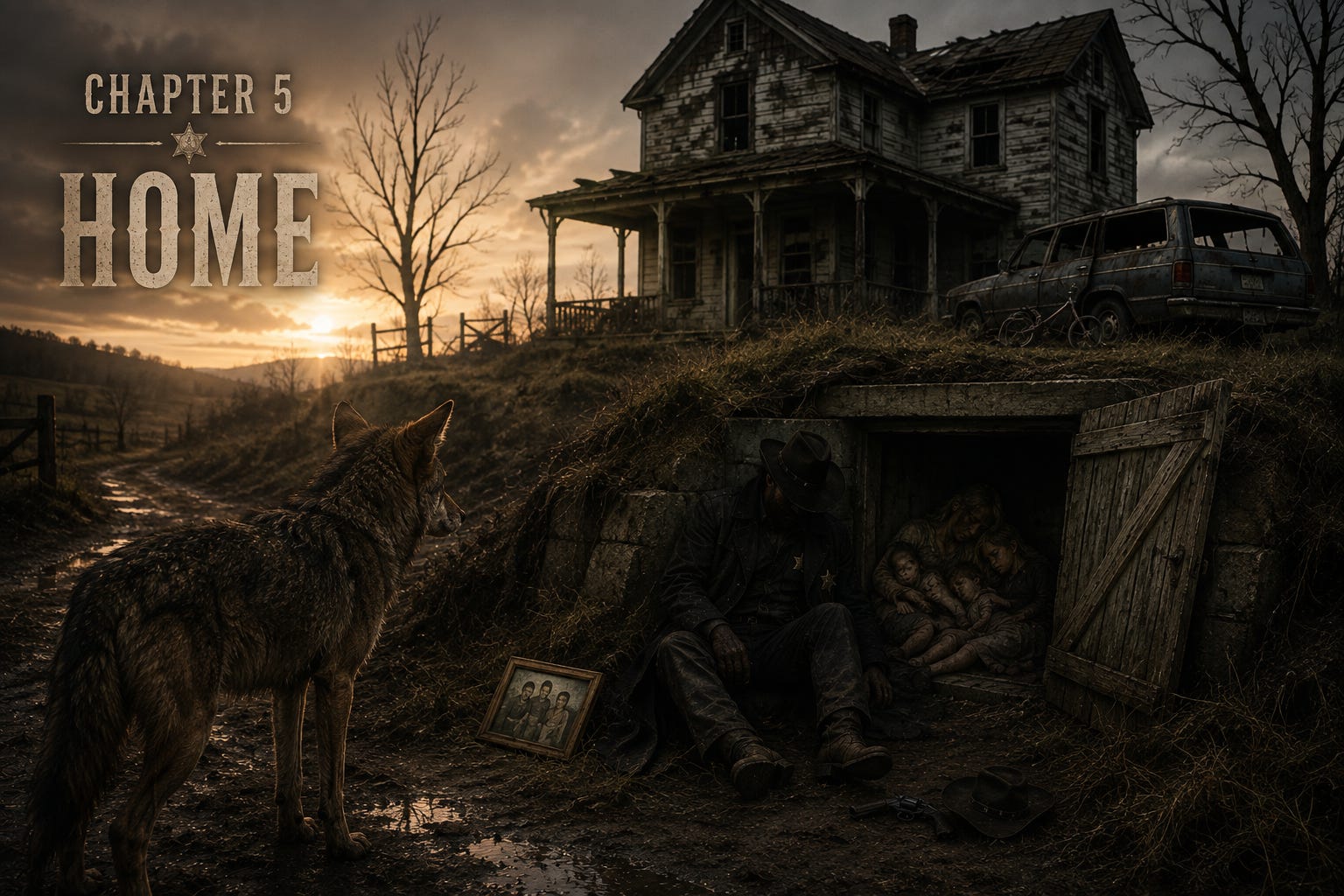
A coyote found him just after dark.
It had been living along the edge of the highway for months, thin enough that its ribs showed beneath a coat gone patchy from mange. It had learned the useful habits of the new world. Abandoned houses sometimes held cans with food still inside, dead people sometimes carried things worth taking, and the dead themselves were best avoided unless hunger left no other choice. The man in the long coat interested it because he was neither useful nor frightened, and the coyote had learned that strange things were sometimes worth watching.
It stayed in the weeds as the Sheriff passed.
He did not look at the animal.
He did not look at the wrecked cars either. There were dozens along the road, some with doors hanging open and others burned down to their frames, but the Sheriff walked past them without slowing. A minivan lay on its side in a ditch with rainwater pooled inside it, its rear doors twisted open and a child’s blanket caught beneath one wheel. He gave it no more attention than the weeds growing through the asphalt.
A mile farther on, he stopped beside an old white station wagon.
The coyote stopped too.
The Sheriff walked around the vehicle, studying it from every side before opening the rear door. A child’s car seat was still strapped into the back, gray with dust and spotted with mildew, and a plastic cup had rolled beneath the passenger seat. The Sheriff leaned inside and looked beneath the front seats, then checked the rear compartment before closing the door. He stood beside the wagon for several seconds, one hand resting on the roof, and then continued down the road.
The coyote followed.
It wasn’t sure why.
Perhaps the man had food.
Perhaps it simply liked the sound of his boots on the pavement.
The Sheriff passed another dozen vehicles without stopping. A pickup with a deer skull hanging from the rearview mirror, a rusted sedan with both front doors missing, an overturned delivery van with weeds growing through the floor, a school bus resting in a field with its emergency door hanging open. None of them caught his attention.
Then another white station wagon appeared ahead.
The Sheriff stopped.
This one had a faded blue stripe along the side and a dent running across the driver’s door. The rear bumper hung crookedly from one bracket, and one tire had sunk so deeply into the soft ground that weeds had grown around the rim. The Sheriff walked to the driver’s side and looked through the broken window.
Something hung from the rearview mirror.
A small wooden cross.
He reached through the window and touched it.
The coyote watched from the roadside.
The Sheriff let the cross fall back against the mirror, stepped away from the wagon, and continued toward the trees.
The animal followed.
The road ended at a small cemetery.
There was no fence around it anymore. Most of the headstones leaned at odd angles, and weeds had swallowed the narrow paths between them, while an overturned riding mower lay half-buried near the shed at the edge of the property. The Sheriff entered without hesitation and walked between the graves, passing one stone and then another until he stopped near the back.
The coyote stayed at the edge of the cemetery.
The Sheriff crouched beside a weathered headstone and brushed away the moss with his fingers. The name beneath it was almost impossible to read, but the date was clear enough. He remained there for a long time, his hand resting against the stone, before rising and walking away.
He did not visit another grave.
The coyote followed him back to the road.
They traveled together for another hour.
The Sheriff never acknowledged the animal, but he didn’t chase it away either.
Near midnight, they reached a farmhouse set well back from the road. The porch had collapsed on one side, and the upstairs windows were dark holes beneath a roof missing several shingles. A child’s bicycle lay in the grass with one wheel twisted sideways, and a faded plastic tricycle rested beneath the porch steps where somebody had left it years ago.
The Sheriff stopped at the gate.
For the first time since the coyote had begun following him, he stayed still for more than a few seconds.
The farmhouse had once been cared for. That was still visible beneath the damage. Someone had planted roses along the front walk, and though the bushes had grown wild, a few pale flowers remained among the dead branches. A wooden swing hung from the porch by one chain, moving slightly whenever the wind passed through.
The Sheriff pushed open the broken gate.
The front door stood ajar.
Inside, dust covered the furniture, and a coffee mug sat on the kitchen counter with a brown stain dried inside it. A calendar still hung beside the refrigerator, the page turned to a month eight months gone, and a grocery list remained pinned beneath a magnet shaped like a yellow school bus. The Sheriff moved through the kitchen and stopped in the hallway where several family photographs still hung on the wall.
Most had fallen.
One remained.
The glass was cracked, but the picture behind it was clear enough.
A woman stood beside the Sheriff, younger than the photograph of him in uniform would have suggested, one hand resting against his shoulder. Two children stood in front of them, a boy with his arm around a smaller girl, all four of them squinting into the sun.
The Sheriff removed the frame from the wall.
He turned it over.
There was writing on the back.
Our family. Always.
His thumb passed over the words.
Then he slipped the photograph inside his coat.
The coyote watched from the porch.
The Sheriff disappeared down the hallway.
A moment later, a door opened somewhere in the back of the house.
Then another.
The coyote lifted its head.
The Sheriff came outside through the rear door and crossed the yard toward a low wooden structure built into the hillside. The doors of the storm cellar stood open, one hanging from a single hinge, and dead leaves had gathered across the first few steps.
He stopped at the entrance.
For several seconds he looked down into the darkness.
Then he descended.
The coyote remained above.
It could see most of the cellar from the doorway, enough to make out the shape of a woman against the far wall and the smaller shapes gathered beside her. The bodies had been there for months, long enough for the clothing to become part of the dirt beneath them, but the woman’s silver wedding ring still caught the faint moonlight whenever the wind moved the cellar door.
The Sheriff reached the bottom of the stairs.
He stood there among them.
Then he removed his hat.
He set it on the step beside him and lowered himself to the floor.
He sat with his back against the stone wall, close enough that his shoulder rested against the woman’s arm. One of the children lay curled against her side, while the other had fallen against her knees. The Sheriff reached over and carefully straightened the little girl’s blanket, though there was nothing left beneath it to keep warm.
The coyote watched from the doorway.
It had seen people sit with the dead before.
Sometimes they cried.
Sometimes they screamed.
Sometimes they held the bodies until someone came to take them away.
The Sheriff did none of those things.
He simply stayed.
The night deepened around the farmhouse. Wind moved through the dead grass above the cellar, carrying the smell of rain from somewhere far off, and the old house creaked as the temperature dropped. The Sheriff remained against the wall with his hat beside him and the family photograph still tucked inside his coat.
Nothing about him moved.
When dawn began to gray the sky, the coyote was still waiting.
Birds had started calling from the woods beyond the house, and somewhere down the road a loose piece of sheet metal banged against an abandoned vehicle. The coyote stood, stretched, and looked down into the cellar one last time.
The Sheriff remained where he had been.
His revolver rested beside his boot.
His hat lay on the step.
His hand rested open against his knee.
The coyote turned and walked away from the house, following the road toward the trees.
It did not see the Sheriff’s fingers move.
It did not see his hand close slowly around the brim of his hat.
And it did not see him lift his head.
The house remained silent behind it.
For the first time since he had opened his eyes beneath the ruins, the Sheriff had reached the place he had been looking for.
Home.